How Your Invoice Affects What You Can Charge: The Psychology of Freelance Pricing
Here's something no freelance pricing guide ever tells you: your invoice is a pricing tool.
Not in the obvious sense — of course the invoice communicates what you charge. But it also shapes whether the client feels good about paying it. Whether they perceive your rate as fair, cheap, or premium. Whether they'll hire you again without negotiating.
Every freelancer obsesses over what to charge. Almost nobody thinks about how the invoice itself reinforces — or undermines — that number. This guide explores the connection between invoice presentation and pricing power.
The Problem Most Freelancers Don't Know They Have
Imagine two freelance brand strategists. Both charge $5,000 for a brand identity package. Both deliver excellent work.
**Freelancer A** sends an email with 'invoice attached.' The attachment is a Google Sheets export. No logo, no design. Line item reads 'Brand strategy — $5,000.' Payment terms say 'please pay when you can.' PayPal email buried below accidental white space.
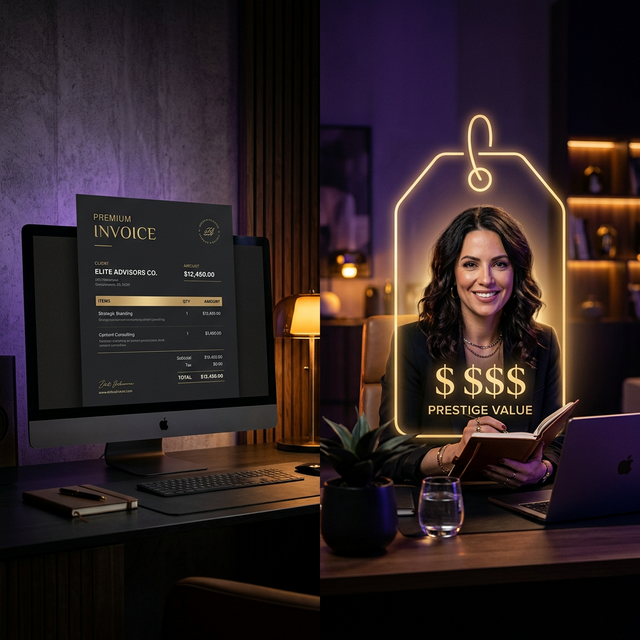
**Freelancer B** sends a cleanly structured email. The PDF: branded with their logo, dark-mode template, carefully itemized — Discovery workshop, Competitive audit, Brand positioning framework, Logo design (3 concepts + 2 refinements), Color palette, Typography system, Brand guidelines. Tax auto-calculated. Terms say 'Net 14 — due April 8, 2026.' Payment details clearly listed.
Same work. Same price. Radically different experience.
Freelancer A's invoice communicates: 'I'm talented but don't care about the business side.' Freelancer B's invoice communicates: 'I run a professional operation, and this is what a $5,000 engagement looks like.' Which one gets paid faster? Which one raises their rates without flinching? Which one gets referrals to other premium clients?
Why Presentation Signals Value (Whether You Like It or Not)
This isn't just an invoicing thing — it's a principle that runs through every aspect of commerce.
- A $50 watch sells for $200 in a plastic case and $5,000 in brushed-titanium with velvet packaging. The watch is identical. The packaging creates a different value perception. - A consulting deck that's beautifully designed commands more respect than the same insights in a plain text email. Content is identical. Presentation signals 'premium' vs. 'casual.'
Your invoice works the same way. It's the packaging around your price. Clients — consciously or not — use it to evaluate whether the number at the bottom feels right.
When an invoice looks premium, the price feels justified. When it looks thrown together, the client wonders if the work was too. They may not refuse to pay — but they're less likely to hire you at the same rate next time, and far less likely to refer you with the enthusiasm that generates premium clients.
You don't need to be a designer. You need five things, executed consistently.
**1. Consistent Branding.** Your logo, your brand colors, a visual identity that matches your website, proposals, and deliverables. When everything a client sees shares the same visual language, cohesion signals professionalism, and professionalism justifies premium pricing.
**2. Itemized Line Items That Showcase Your Process.** 'Website design — $8,000' is just a number — and numbers without context invite negotiation. Break the same project into 8 specific deliverables and the client sees the scope, the effort, the expertise. Each line is a reminder of something you delivered. By the time they reach the total, it feels like a fair deal — maybe even a bargain.
**3. Explicit Payment Terms That Signal Control.** 'Please pay when convenient' communicates no financial standards. 'Net 14 — due April 8, 2026. Late fee of 1.5%/month applies to overdue invoices' communicates that you have terms, you enforce them, and you expect professional conduct. Firm terms make clients respect you. Respect is the foundation of pricing power.
**4. A Clean, Modern Design.** Clean typography, adequate white space, logical visual hierarchy. Your invoice's visual quality is a proxy for your work quality. A developer sending a well-designed invoice: 'This person cares about every detail.' A designer sending an ugly invoice: jarring cognitive dissonance.
**5. A Polished PDF — Not a Spreadsheet, Not a Link, Not a Screenshot.** PDF is the universal standard for professional documents. Renders identically on every device. Printable. Archivable. What every accounts payable team expects. A .xlsx looks like a draft. A Google Sheets link looks informal. Always send PDF. Always.
How Better Invoicing Actually Lets You Charge More
**It reduces negotiation.** A premium invoice with detailed line items clearly justifies the total — answering 'is this worth it?' before the client even asks. Vague invoices invite scrutiny. Polished invoices invite approval.
**It increases repeat work at the same (or higher) rate.** When billing is smooth — clear terms, professional formatting, easy payment — clients associate working with you with ease and quality. You become their trusted provider, not a commodity compared on price.
**It generates referrals to higher-value clients.** When clients refer you, they stake their reputation on your professionalism. If every touchpoint was polished — including the invoice — they'll refer you with confidence. Confident referrals land premium clients.
**It supports rate increases.** When you raise rates by 15% next year, the client who received professional invoices throughout is far more likely to accept without pushback. They've already internalized that you run a premium operation. But the client who received messy invoices? They'll question the increase — because your billing never gave them a reason to believe you were premium to begin with.
The Two-Minute Investment That Pays for Itself
Everything in this guide comes down to one practical action: use a tool that makes your invoices look as good as the work you deliver.
You don't need to hire a designer. You don't need an hour in Illustrator. You don't need a $50/month subscription. You need a tool that handles formatting, math, tax logic, and PDF export — so the output is always professional, regardless of how much time you spend on it.
That's what OWN. Invoice Generator is built for. Pick a template that matches your brand's energy: - **Minimalist Mono** for understated professionalism - **Kinetic Indigo** for creative impact - **Obsidian Night** for high-end authority
Upload your logo. Fill in the details. Download a PDF that looks like it was produced by a creative agency with a billing department. Two minutes. Zero cost. And every invoice you send from this point forward actively reinforces the value of what you charge.
A Note on Pricing Confidence
When you send an invoice that looks premium, you feel different about the number at the bottom. The confidence isn't just for the client's benefit — it's for yours.
Many freelancers struggle with pricing not because they don't know their worth, but because nothing in their business infrastructure supports the rates they want to charge. Their website is okay. Their contract is a Google Doc. Their invoice is a hacked-together spreadsheet. Everything around the work is mediocre, even when the work itself is excellent.
When you upgrade your invoice — when the document requesting payment actually looks like it belongs to a $5,000 or $10,000 engagement — something shifts internally. You stop second-guessing your rates. You stop adding apologetic language to emails. You stop offering unsolicited discounts. Because the invoice matches the value, and you can see it right there on the page.
This is the difference between freelancers who charge $50/hour for ten years and those who move to $150/hour within three years. The work quality isn't necessarily different. The packaging is.
Advantages
- Premium invoice presentation reduces price negotiation and justifies your rates
- Detailed line items prevent disputes by making scope visible before payment
- Consistent branding across all touchpoints builds client trust and referrals
- Professional invoices support rate increases on repeat engagements
- Sending a polished invoice boosts your own pricing confidence
Considerations
- Sloppy invoices from talented freelancers actively undermine their rate positioning
- Generic templates with no branding signal 'commodity' rather than 'specialist'
- Vague payment terms invite clients to delay payment indefinitely
- Inconsistent invoice formats across projects create a sense of disorganization
Common Questions
Q.Can my invoice design really affect whether clients pay my rates?
Yes — and the effect is well-documented in behavioral economics. Presentation creates perceived value. When every element of a service interaction looks premium — including the invoice — clients are less likely to question the price, more likely to pay promptly, and more likely to return at the same or higher rate.
Q.What should I include in my invoice line items to justify my rates?
Break your work into specific, named deliverables. Instead of 'design work — $3,000,' list every component: brand discovery session, competitive analysis, logo concepts (3), revision rounds (2), final files (web + print + vector). Each line item reinforces the depth of your work and makes the total feel earned.
Q.How do I start charging more as a freelancer?
Raise your rates incrementally — 10–20% per project or per year — and ensure your entire client experience supports the higher price point. That includes your pitch, your contract, and your invoice. If one element looks cheap, it undercuts everything else. A professional invoice is often the quickest upgrade you can make.
Q.Is it worth using a branded invoice template?
Absolutely. Consistent branding across all client-facing materials — proposals, contracts, deliverables, invoices — creates a sense of professionalism that standalone generic templates never achieve. Clients notice the coherence even if they can't articulate why it makes them trust you more.
Q.Does the invoice format affect how quickly I get paid?
Yes. Professional PDFs with clear payment terms, multiple payment options, and a specific due date get processed faster than informal invoices with vague terms. Accounts payable teams are trained to handle formal documents — an invoice that looks official gets routed and paid faster than one that looks like an afterthought.
Key Takeaways
Your invoice is the last touchpoint of every project. Most freelancers invest in the pitch and the work but phone it in on the invoice — the very document that asks for money, determines whether the relationship continues, and shapes whether the client refers you with enthusiasm or as an afterthought.
Closing Thoughts
Start with your next project. Create an invoice that's as polished as your portfolio. As detailed as your deliverables. As professional as the rate you want to charge. And see what happens when your billing finally matches your brilliance.